
Disclaimer: The following is for educational purposes only and does not constitute financial advice. See full disclaimer at the bottom of the page.
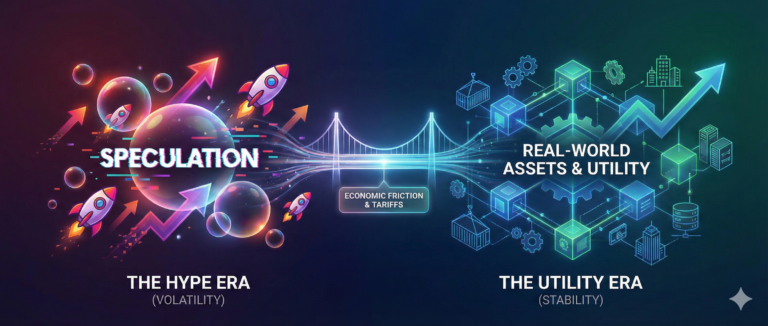
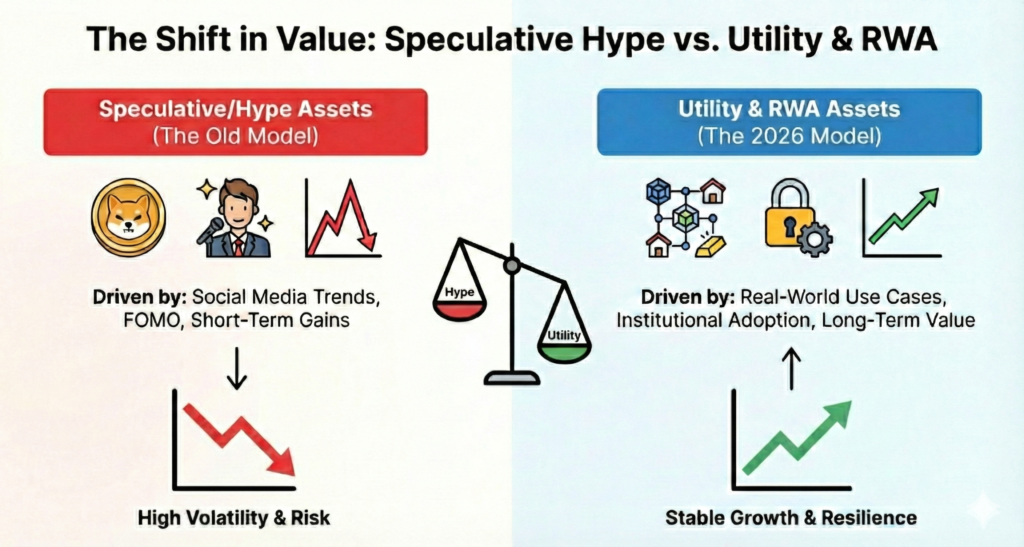
🚨 Market Update: February 23, 2026 The immediate fallout from this weekend’s abrupt shift to a 15% global tariff is actively hammering both Wall Street and the digital asset space. As the Dow plunges over 600 points, the broader crypto market has followed suit, with Bitcoin sliding below $65,000 and the Fear & Greed Index dropping into “Extreme Fear.” However, today’s sell-off is exposing a critical bifurcation in the market: while speculative meme and gaming tokens are crashing by double digits, AI-driven infrastructure and tokenized Real-World Assets (RWAs) are showing remarkable resilience. The market is proving in real time what this article explores below: the “hype era” is over, and utility-backed financial rails are the new safe havens in a volatile global economy.
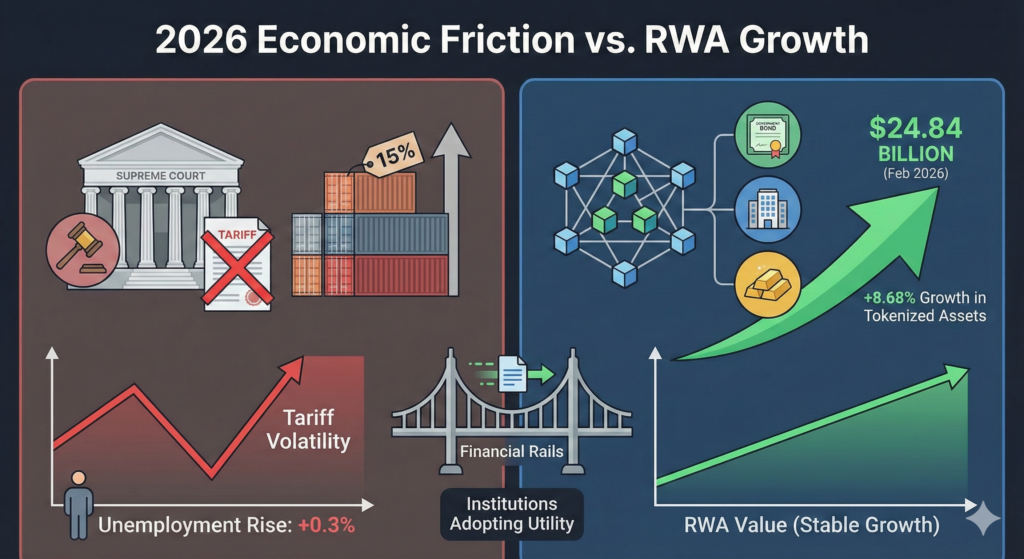
In early 2026, the global economy is no longer just “talking” about digital transformation—it is being forced into it. The recent volatility sparked by shifting U.S. tariff policies and the sudden implementation of broad import surcharges has highlighted a critical flaw in global commerce: legacy systems are too slow and too expensive to survive policy whiplash.
While traditional markets struggle to price in the rising costs of global supply chain disruptions, a specific sector of the digital asset market is thriving: Real-World Assets (RWA). The value of tokenized assets has defied broader market downturns, growing steadily to reach nearly $25 billion.
The experimental era of blockchain is over. Today, institutional capital is rotating away from speculative tokens and into “Financial Rails”—the underlying protocols that allow businesses to move money, track goods, and verify data without the friction of traditional banking.
Here are the top 10 utility-driven digital assets serving as the infrastructure for the 2026 economy, ranked by their practical investment value.
The Top 10 Utility Assets for 2026: Ranked by Investment Value
As you look to position your portfolio for the remainder of 2026, these 10 assets represent the “picks and shovels” of the new economy.
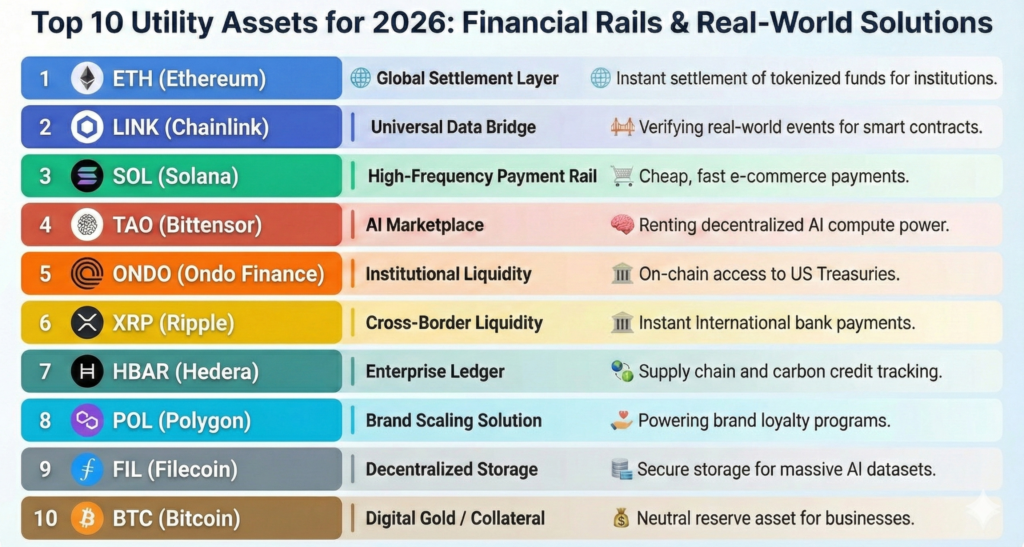
The Top 10 Utility Assets for 2026
1. Ethereum (ETH) – The Global Settlement Layer
- Use Value: Ethereum is the foundational “rail” for the RWA movement. In 2026, major financial institutions utilize the network to issue and settle tokenized funds instantly.
- Utility Example: Multinational corporations using smart contracts to automate cross-border vendor payments that trigger the moment a shipment clears customs, eliminating escrow delays.
2. Chainlink (LINK) – The Universal Data Bridge
- Use Value: Blockchain without real-world data is a closed loop. Chainlink acts as the bridge, allowing traditional banking systems to securely interact with public ledgers.
- Utility Example: Feeding real-time weather data or shipping container GPS coordinates into a decentralized insurance protocol to automatically pay out claims for delayed or damaged cargo.
3. Solana (SOL) – The High-Frequency Payment Rail
- Use Value: With tariffs driving up consumer costs, businesses are desperate for cheaper payment methods. Solana’s near-zero fees and sub-second finality make it the primary blockchain choice for retail and high-volume transactions.
- Utility Example: Global e-commerce platforms integrating decentralized pay infrastructure to bypass traditional 3% credit card processing fees, helping merchants offset the rising cost of imported goods.
4. Bittensor (TAO) – The Marketplace for Artificial Intelligence
- Use Value: Bittensor provides a decentralized marketplace for AI compute. In a landscape where high-end processing chips are scarce and expensive, it allows developers to crowdsource AI power from a global network.
- Utility Example: Software startups renting decentralized GPU power to train and run complex machine-learning models at a fraction of the cost of centralized cloud providers.
5. Ondo Finance (ONDO) – Institutional Liquidity on Demand
- Use Value: Ondo brings traditional, yield-bearing assets onto the blockchain. It allows investors and corporations to earn a stable yield on their digital capital with minimal risk.
- Utility Example: Corporate treasuries holding cash reserves in tokenized U.S. Treasuries, earning passive interest while remaining highly liquid and accessible 24/7.
6. XRP – The Cross-Border Liquidity Bridge
- Use Value: Designed to modernize outdated international wire systems, XRP enables “On-Demand Liquidity” (ODL), allowing financial institutions to settle cross-border payments in seconds instead of days.
- Utility Example: Converting USD to a foreign currency instantly for international manufacturing payments, without the need for the sender to maintain pre-funded accounts in the destination country.
7. Hedera (HBAR) – The Enterprise Ledger
- Use Value: Governed by a council of global tech and business giants, Hedera is built specifically for corporate scale, making it the leading network for high-throughput tracking and reporting.
- Utility Example: Managing complex supply chain logistics and tracking the exact carbon footprint of industrial shipments to ensure compliance with strict international ESG regulations.
8. Polygon (POL) – The Scaling Solution for Brands
- Use Value: Polygon is the preferred network for massive consumer brands building out their Web3 presence. It provides the robust security of Ethereum while keeping user transaction costs negligible.
- Utility Example: Large retail brands launching tokenized loyalty programs that allow millions of customers to trade and redeem rewards without experiencing network congestion or gas fees.
9. Filecoin (FIL) – The Decentralized Data Warehouse
- Use Value: As the AI boom generates unprecedented amounts of data, centralized storage is becoming a massive bottleneck. Filecoin provides a decentralized, highly auditable way to securely store massive datasets.
- Utility Example: Archiving petabytes of raw data required for training enterprise AI systems, ensuring the data cannot be altered or taken offline by a single centralized server failure.
10. Bitcoin (BTC) – The Hard Asset / Digital Gold
- Use Value: Bitcoin has cemented its role as a “Digital Hard Asset.” In a world of fluctuating fiat currencies and macroeconomic friction, it serves as the ultimate neutral reserve.
- Utility Example: Businesses utilizing their decentralized digital reserves as collateral to secure fiat credit lines, maintaining their asset positions while accessing operational liquidity.

Conclusion: The Road Ahead
The 2026 economic landscape is punishing speculation but rewarding infrastructure. As the U.S. and its trading partners navigate the fallout of the latest tariff increases, the businesses and investors who succeed will be those who leverage these “digital rails” to build faster, cheaper, and more resilient systems.
The content of this article is intended for general information purposes only. It should not be construed as professional financial, investment, or legal advice.
Investing in cryptocurrencies, digital assets, and decentralized finance (DeFi) involves significant risk. Prices are highly volatile, and you could lose your entire investment.
Any forward-looking statements or predictions regarding the 2026 economic landscape, tariffs, or specific cryptocurrency valuations are speculative and not guaranteed.
We strongly recommend consulting with a certified financial planner or legal professional before executing any trades or investments. The author and publisher assume no responsibility or liability for any financial losses or damages resulting from the use of this information.